What Is Vedic Astrology? A Complete Beginner's Guide to Jyotish
Somewhere between science, philosophy and self-reflection sits a tradition that has guided Indian life for generations — Vedic astrology, known in Sanskrit as Jyotish, literally "the science of light." Whether you have heard the term from a family elder, encountered it while searching for life guidance, or simply come across the phrase "Vedic astrology" online and wondered what it actually means, this guide will walk you through it in plain, modern language.
At AADIKARTA, we believe astrology should be understood before it is practiced or judged. This article explains what Vedic astrology is, where it comes from, how it works, how it differs from the astrology most people see in Western newspapers and apps, and how to approach it in a grounded, practical way — without hype, fear, or guaranteed predictions.
What Does "Vedic Astrology" Actually Mean?
Want to know how planetary transits affect your birth chart?
Consult top verified Vedic astrologers or ask our 24/7 AI Astrologer instantly.
Vedic astrology refers to a system of astrology that originated in the Indian subcontinent and is deeply connected to the Vedic tradition — the body of ancient Indian knowledge that also gave rise to yoga, Ayurveda and Sanskrit philosophy. In Sanskrit, this system is called Jyotish Shastra, often translated as "the science/study of light" or "the science of celestial bodies."
The core idea behind Jyotish is simple to state, even though its practice is layered and detailed: the positions of the Sun, Moon and planets at the moment of a person's birth are recorded as a kind of cosmic snapshot, and this snapshot — called a birth chart or Kundli — is studied as a symbolic map of that person's life patterns, tendencies and potential timing of events.
It is important to understand Jyotish as a descriptive and reflective tool, not a system of fixed, unavoidable fate. Traditional Vedic thought consistently emphasizes free will (purushartha) alongside destiny (prarabdha karma) — the chart shows tendencies and potential, not an unchangeable script.
The Origins of Vedic Astrology
Jyotish is traditionally counted among the Vedangas — the six auxiliary fields of study connected to the Vedas — where it played a practical role in determining the correct timing for rituals and ceremonies. Over centuries, this timekeeping function expanded into a broader system for understanding human life, personality and life events through the movement of celestial bodies.
Unlike some spiritual traditions where origins are shrouded in myth alone, Jyotish developed as a structured discipline with its own mathematics (astronomy), symbolism, and interpretive framework, refined and transmitted across generations. It is worth noting honestly: precise dates, authorship and the evolution of specific techniques are debated among scholars, and AADIKARTA does not claim exact historical certainty where none exists in the wider record. What can be said with confidence is that Jyotish is an old, continuous and living tradition, still actively practiced and studied today.
The Core Building Blocks of Vedic Astrology
To understand how Jyotish works, it helps to know its basic vocabulary. Here are the essential concepts, explained simply.
1. Graha (Planets)
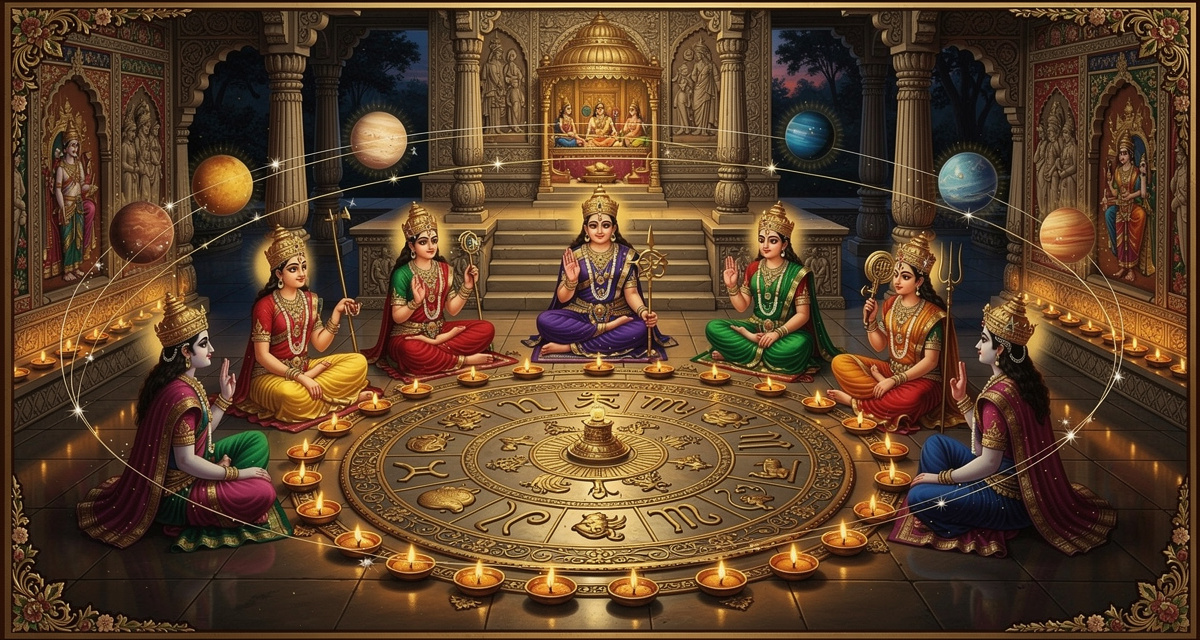
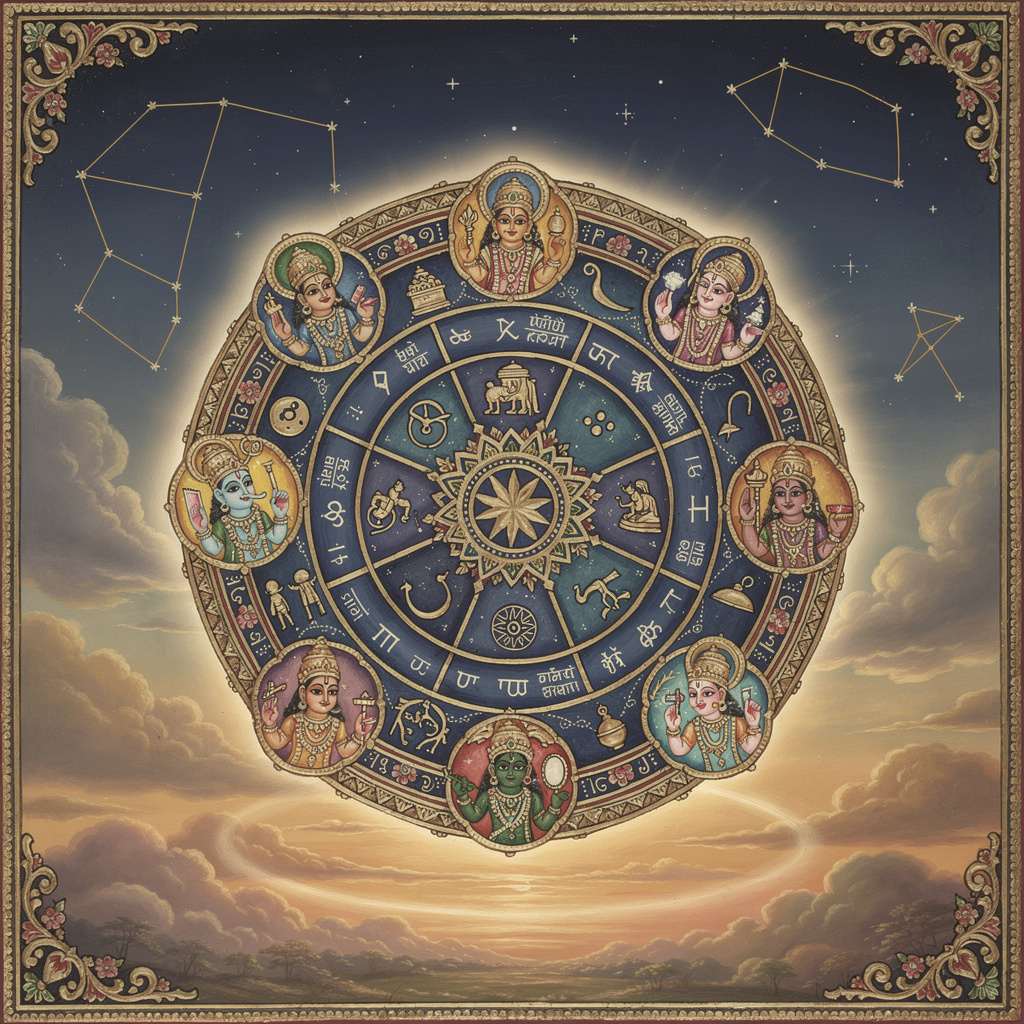
In Vedic astrology, nine celestial bodies — called Navagraha — are considered significant: the Sun (Surya), Moon (Chandra), Mars (Mangal), Mercury (Budh), Jupiter (Guru), Venus (Shukra), Saturn (Shani), and two mathematical points called Rahu and Ketu (the lunar nodes, representing the points where the Moon's orbit crosses the Sun's apparent path). Each Graha is associated with particular themes — for example, the Moon is linked to the mind and emotions, while Jupiter is linked to wisdom, growth and expansion.
2. Rashi (Zodiac Signs)
Just like Western astrology, Jyotish divides the sky into twelve Rashis, or zodiac signs — Mesha (Aries), Vrishabha (Taurus), and so on. However, as explained below, Vedic astrology calculates these signs differently than Western astrology does.
3. Bhava (Houses)
The birth chart is divided into twelve Bhavas, or houses, each representing a life area — such as self and personality (1st house), wealth and family (2nd house), communication (3rd house), home and mother (4th house), and so forth, through to career, relationships, health and spirituality.
4. Nakshatra (Lunar Mansions)
A distinctive feature of Vedic astrology is its use of 27 Nakshatras, or lunar constellations, each spanning a smaller segment of the zodiac. The Nakshatra in which the Moon sits at birth is considered especially significant for personality and timing, adding a layer of detail not found in most Western astrology systems.
5. Kundli (Birth Chart)
All of the above — planetary positions, signs, houses and Nakshatras — are compiled into a chart called a Kundli or Janam Kundli, calculated using the exact date, time and place of birth. This chart is the primary tool a Jyotish practitioner works with.
6. Dasha (Planetary Periods)
Vedic astrology also includes a distinctive timing system called Dasha, most commonly the Vimshottari Dasha, which divides a person's life into planetary periods ruled sequentially by different Grahas. This is one of the ways Jyotish attempts to indicate when certain life themes may become more prominent, rather than only what those themes might be.
Vedic Astrology vs. Western Astrology: What's the Real Difference?
Many people are surprised to learn that Vedic and Western astrology, despite sharing some vocabulary (planets, houses, zodiac signs), are calculated quite differently. Here is a simple comparison.
AspectVedic Astrology (Jyotish)Western AstrologyZodiac usedSidereal (based on fixed star positions)Tropical (based on the Earth's seasons)Ayanamsa adjustmentYes — accounts for the slow shift of the equinoxesNoEmphasisMoon sign (Rashi) and Nakshatra often given primary weightSun sign is often given primary weightTiming toolsDasha systems for event timingTransits and progressionsCultural rootsIndian/Vedic traditionGreco-Roman tradition
The most technical — and most important — difference is the sidereal vs. tropical zodiac. Because of a slow astronomical shift called the precession of the equinoxes, the tropical zodiac used in Western astrology and the sidereal zodiac used in Vedic astrology have drifted apart over time by roughly 24 degrees. This is why a person's "sign" can genuinely differ between the two systems — it isn't a contradiction or an error, simply two different reference frameworks.
Myth vs. Reality in Vedic Astrology
Vedic astrology is often misunderstood, partly due to sensationalized portrayals. Here are a few common myths, addressed honestly.
Myth: "Vedic astrology can predict the exact date of any event with certainty."
Reality: Reputable Jyotish practice deals in tendencies, probable periods and thematic guidance — not guaranteed, fixed outcomes. Life includes free will, effort and circumstance alongside any chart-based indication.
Myth: "A difficult planetary placement means a person is doomed to suffering."
Reality: Traditional Jyotish philosophy treats challenging placements as areas requiring awareness, effort or remedial practice — not as an unchangeable curse. Fear-based interpretations are a distortion of the tradition, not its foundation.
Myth: "Vedic astrology is the same as Western astrology, just with Indian names."
Reality: As shown above, the underlying zodiac calculation, emphasis and timing tools are genuinely different systems.
Myth: "You need to believe in astrology for a birth chart reading to have any value."
Reality: Many people engage with Jyotish the way they might engage with journaling, self-reflection tools, or personality frameworks — as a lens for thinking about patterns, timing and choices, not as a replacement for personal judgment.
A Practical Example
Consider two people born on the same date but a few hours apart. Because Jyotish relies on the exact time and place of birth (not just the date), their Ascendant (Lagna) — the sign rising on the eastern horizon at the moment of birth — may fall in entirely different signs. This single difference reshapes how the entire chart is read, since every house is measured relative to the Ascendant. This is one reason Vedic astrologers place strong emphasis on obtaining an accurate birth time before offering any interpretation — approximate times can meaningfully change the analysis.
Practical Guidance: How to Approach Vedic Astrology Thoughtfully
If you are exploring Jyotish for the first time, a few grounded practices can help:
Get an accurate birth time. Check your birth certificate or hospital record where possible; even small errors can shift key chart calculations.
Treat the chart as a mirror, not a verdict. Use it to reflect on tendencies and timing, while keeping your own judgment and agency central.
Be cautious of fear-based readings. Any interpretation built around urgent fear, expensive "remedies," or guaranteed predictions is a red flag, not authentic tradition.
Learn the basics yourself. Understanding your Rashi, Nakshatra and Ascendant gives you a foundation to engage critically with any reading you receive.
Pair it with practical action. Traditional Jyotish was never meant to replace effort, planning or professional advice — in health, finance, career or relationships.
Conclusion
Vedic astrology, or Jyotish, is far more than a mystical curiosity — it is a structured, symbolic system rooted in Indian tradition, built around real astronomical calculations and centuries of interpretive knowledge. At its best, it offers a language for self-reflection: understanding tendencies, recognizing cycles, and thinking about timing with a bit more awareness. It is not a tool for guaranteed predictions or fear, and it works best when approached with curiosity, honesty and personal responsibility. Whether you are drawn to it out of cultural connection, personal curiosity, or a search for perspective, understanding what Vedic astrology actually is — separate from myth and sensationalism — is the right first step.